_edited.png)


ABOUT
Goldenrod & Co. is a Nova Scotia based practice working on the unceded territory of the Mi'kmaq people, where biodiversity restoration, art, design, and education meet. We work across residential, community, and commercial landscape projects to support habitat, biodiversity, and resilient ecosystems.
Led by women, queer, neurodiverse, and disability identified practitioners, we approach landscape work as an evolving and community informed practice.
We approach this work as a place of curiosity, engagement, and play where cross-disciplinary collaborations can take root and evolve.
Goldenrod & Co. has been many years in the making. Not through a straight line, but through turns, pauses, and returnings. We created this practice to build a workspace that feels safe, inclusive, and grounded, where we can thrive alongside community rather than apart from it. Our work is shaped by listening, collaboration, and shared knowledge rather than hierarchy or ownership.
We collaborate, observe, adapt, and share knowledge openly, treating restoration not as a fixed solution, but as an ongoing relationship between people, land, and more than human life.



Justyna Werbel is a co-founder of Goldenrod & Co. She works at the intersection of art, design, and environmental communication, with a deep focus on native plant knowledge and biodiversity, alongside restoration-based design thinking and sustainable, regenerative product development. Recently, she has been developing innovative mycelium-based biostimulants and exploring new approaches to regenerative product design. Her work brings ecological ideas into practical, community-informed projects, and her practice is shaped by deep listening, systems-based thinking, and close attention to place.
With a background in industrial design and having pursued a master’s thesis focused on soundscape ecology, she is guided by more-than-human teachers; from soil communities to mycelial networks, pollinators, shoreline edges, and ethical seaweed farming. With years of experience in contemporary art curation, production, and as a teaching assistant in the Art in Public Spaces department, she brings a strong foundation in collaboration, creative problem-solving, and public-facing work. She has also led international, community-based projects, produced accessible education, and supported multidisciplinary teams, helping clients feel confident as their landscapes shift toward more resilient, habitat-rich ecosystems.

Emillie Rose is a co-founder of Goldenrod & Co. Her field of study encapsulates wildlife & fisheries identifications and practices, ecosystem functions & restoration, and environmental education. With a passion for the ocean and the systems that converge there, her experience includes instruction on riparian sampling and data collection, data collection on wildlife habitats and behaviours, as well as population and water chemistry data. She has worked for years in the field of restoration in management positions, with a focus on living shorelines, forestry, upland restoration, and ecological landscaping practices. Through this time she has led and overseen teams and supervisors, as well as carried out projects from research & planning to implementation.
She acted as an educational instructor during her studies, as well as afterwards. She has participated in and led community and municipal workshops through Nova Scotia, New Brunswick, and PEI, instructing community members and municipal representatives on the care and creation of living shoreline ecosystems and other nature-based solutions. With her first scientific publication written at the age of 17, Emillie is skilled in communicating through the written word and interpreting scientific material. She was an instructor for 3 years in a program focused at helping high school level students prepare research for scientific papers. She has also acted as an educator for high school students on topics such as restoration, water sampling, species identification, and career paths in the environmental field for the last 8 years.

EXPERIENCE
We have worked closely with organizations both nationally and internationally, with a strong background in community engagement and large scale collaborative projects.
Across Atlantic Canada, we have managed initiatives ranging from shoreline mitigation and food forest development to lawn to meadow conversions, and other biodiversity focused landscape work. Our interdisciplinary backgrounds in art, design, and environmental studies inform how we work and shape the structure and values of Goldenrod & Co.
Goldenrod & Co. is a platform as much as it is a practice. We share resources for homeowners, gardeners, and land stewards, and make space for accessible and engaging content, from field notes and observations to readings, research, and ideas we have been fortunate to learn from. We do not claim to be experts on all matters. We see ourselves as contributors who listen, research, ask questions, and remain open to being changed by what we learn.
WHY Goldenrod & Co. ?
.png)
/moon
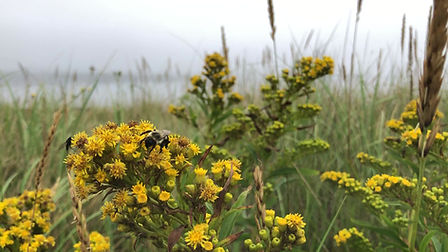
We chose the name Goldenrod & Co. because it invites conversation. It unsettles assumptions. It asks people to reconsider what they think they know about plants and landscapes. Understanding those layers is central to our work in biodiversity, ecological gardening, and landscape stewardship. Goldenrod is often blamed for seasonal allergies or dismissed as an invasive weed. In Atlantic Canada, including Nova Scotia, it is native. Its pollen is heavy, insect-pollinated. It does not drift. Ragweed, flowering at the same time, is usually responsible.
Goldenrod is not invasive here, though it can be invasive elsewhere. Outside its native range, it behaves differently. This distinction matters. In a global, mobile world, ideas of native and invasive are regional, contextual, and always shifting. Goldenrod is assertive. It spreads. It holds ground. It appears where land has been disturbed. This is not a flaw. It is a strategy. It stabilizes soil. It supports insects. Late in the season, when much of the landscape has gone quiet, it remains. Pollinators gather. Biodiversity persists.
The plant is salt tolerant, thriving along roadsides and coastlines where others fail. It reminds us that local ecologies matter that pollinators are local, meadows are specific, and there are no universal solutions.
Goldenrod also appears in Mi’kmaq ethnobotanical records, where its medicinal properties are noted. We acknowledge this knowledge as part of an ongoing relationship with place.
The “& Co.” refers to everything that lives alongside it; flora, fauna, and fungi, the visible and unseen systems that shape an ecosystem. No plant exists alone.
OUR MISSION & VALUES
Our mission is to design, steward, and care for living landscapes in ways that increase biodiversity over time through supporting wildlife, pollinators, soil health, fungi, and the human partners required to sustain them. We work with what already exists, recognizing that fertility does not equal biodiversity, that dominance is part of ecology, and that complexity not tidiness creates resilience.
We believe restoration is not a fixed outcome but a relationship: between people and land, between species, between past and future. Our work evolves as landscapes evolve.
Goldenrod & Co.’s goal is not to claim land, solutions, or expertise, but to participate responsibly in the work of restoring biodiversity where we live. We focus on ecosystems and landscapes as shared, living systems, shaped by many forces such as ecological, cultural, political, and historical. We approach restoration as an ongoing, relational practice rather than an act of control.
We aim to help create conditions where biodiversity can return, persist, and adapt, while remaining accountable to place, people, and the limits of our own knowledge.